If you want to lower your golf handicap, the answer is not simply to hit the ball farther or spend more hours at the driving range. Handicap improvement comes from consistently reducing the strokes you lose through poor decisions, missed short putts, penalty shots, and inconsistent approach play. This guide from Golficial explains where to focus your practice, how to manage your game, and how to use your score data to make meaningful progress.

1. Identify where you are losing strokes
Before changing your practice routine, find out where your strokes are actually going.
1.1. Track your performance after every round
Do more than record your final score. If possible, track:
- Fairways hit
- Greens in regulation
- Total putts
- Three-putts
- Penalty strokes
- Up-and-down attempts
- Double bogeys or worse
For example, if you regularly have two or three three-putts per round, spending more time on driving may not address your biggest scoring problem.
1.2. Find the biggest weaknesses in your game
Try to separate technical mistakes from decision-making mistakes. You may miss a green because of an inconsistent swing, but you may also miss it because you chose an aggressive target with little margin for error.
Both affect your score, but they require different solutions. A golf lesson may help with a technical issue, while better course management may address a decision-making problem.
2.3. Set a realistic handicap goal
Instead of expecting your handicap to fall after every good round, set a longer-term target.
For example, a golfer with a Handicap Index of 20 might first aim to consistently produce scores that support a lower index, rather than immediately targeting a single-digit handicap.
The goal should be based on your current performance, available practice time, and the areas where you can realistically save strokes.
2. Improve your short game to save more strokes
Short game deserves serious attention because mistakes around the green can quickly turn a manageable hole into a high score.
- Improve your chipping consistency: Practise chips from different lies and distances, focusing on both direction and distance control. The goal is to leave a manageable putt rather than trying to hole every chip.
- Develop reliable pitching and bunker skills: Practise different pitch distances and learn to control bunker shots based on the amount of sand and the distance you need. Reliable recovery shots can help limit damage after a poor approach.
- Learn to get up and down: Up and down means getting the ball onto the green and finishing the hole in two strokes. Improving this skill can help you save strokes when you miss the green.

3. Become a more consistent putter
Putting is another area where small improvements can make a noticeable difference to your score. You can focus on the following areas to improve your putting:
- Reduce three-putts: For longer putts, focus on distance control rather than trying to hole the first putt. Practise from different distances and aim to leave the ball within a comfortable range of the hole.
- Improve your short putting: Build a simple practice routine around the short putts you commonly face. Focus on a consistent setup, line, and pace to make these putts more reliable.
- Build a repeatable putting routine: Develop the same pre-putt routine for every stroke. Read the green, choose your line, assess the pace, and commit to the shot without repeatedly changing your decision over the ball.
4. Make your iron shots more reliable
Approach shots can have a significant impact on your score. You can focus on the following areas to make your iron play more consistent:
- Improve your distance control: Know your realistic carry distances for each club and practise hitting specific yardages rather than only full shots. Consider factors such as strike, wind and course conditions when choosing a club.
- Improve your approach shot accuracy: Practise approach shots from different distances and lies to become more comfortable in real course conditions. Focus on giving yourself a realistic chance to finish the hole without taking unnecessary risks.
- Choose smarter targets: The flag is not always the best target. When the pin is close to a hazard or the edge of the green, aim for a safer area and give yourself a better chance of avoiding a difficult recovery.
5. Improve your driving without chasing distance alone
Distance can be useful, but a good tee shot also needs to leave you in a manageable position for the next shot. You can work on the following areas:
- Find a reliable tee shot: Focus on developing a tee shot that you can repeat consistently. A slightly shorter drive that stays in play can often be more valuable than a longer shot that creates a difficult recovery.
- Understand when to use a driver: Consider the fairway width, hazards, wind and your expected second shot before automatically reaching for the driver. On some holes, a shorter club may give you a more predictable approach.
- Reduce penalty strokes from the tee: Identify OB, water and other hazards before hitting. Choose a target that gives you enough margin for your normal shot pattern and reduces the chance of losing a ball or taking a penalty.

6. Learn course management and avoid big numbers
Good course management is about making decisions that match your actual ability and the conditions on the course. Consider these areas during your next round:
- Play to your strengths: Choose clubs and strategies that suit your most reliable shots. If a certain club gives you better accuracy or leaves you with a more comfortable approach, use that advantage when appropriate.
- Manage risk around hazards: Before each shot, consider both the potential reward and the consequences of a miss. A safer target can often be the better choice when an aggressive shot brings water, OB or another major hazard into play.
- Turn triple bogeys into double bogeys: When you make a mistake, focus on limiting the damage rather than trying to recover the hole with another risky shot. Getting the ball safely back into play can prevent one bad shot from becoming a very high score.
7. Build a golf practice routine that actually works
More practice does not always mean better results. A focused routine can help you spend more time on the areas that are actually costing you strokes:
- Divide your practice time by priority: Use your recent rounds to identify your weakest areas and give them more attention. Your practice time does not need to be divided equally between driving, iron play, short game and putting.
- Practise with specific targets: Instead of hitting balls without a clear goal, practise specific distances, landing areas or putting challenges. This makes your practice more purposeful and closer to the situations you face on the course.
- Combine range practice with on-course practice: Use the driving range to work on technique and repetition, then apply those skills on the course. Playing nine holes with a specific focus, such as avoiding penalties, can help turn practice into better decisions.
8. Use golf technology and data to improve your handicap
Golf technology can help you understand your performance more clearly and make better decisions. You can consider the following tools and approaches:
- Use a golf GPS or rangefinder: Accurate distance information can help with club selection and target choice. However, knowing the distance to the flag does not automatically mean the flag is the right target.
- Track your Strokes Gained data: If available, use Strokes Gained to compare your performance across driving, approach, short game, and putting. This can help identify weaknesses that may not be obvious from your final score alone.
- Review your rounds over time: Look for patterns across several rounds rather than focusing on one good or bad day. Recurring problems are more useful indicators of where you should focus your next practice sessions.
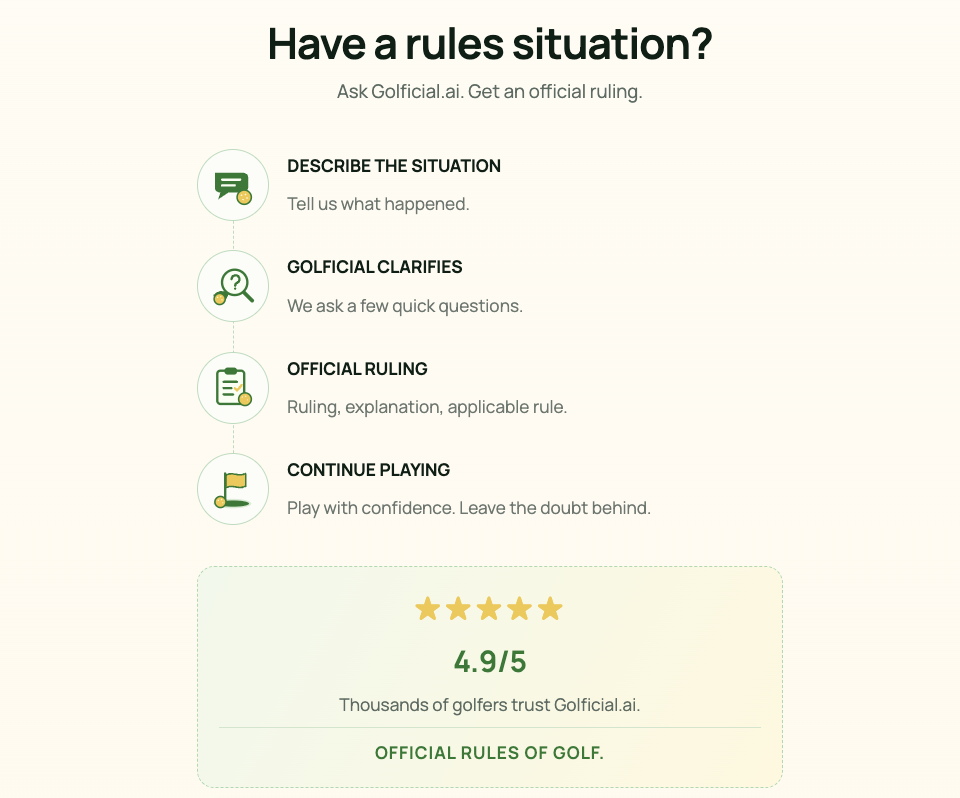
- Use AI-powered guidance for rules and course knowledge: Understanding the rules can help you handle unfamiliar situations correctly and avoid unnecessary penalties. Tools such as Golficial can provide AI-powered guidance for real-world golf rules questions and help golfers explore course and local-rule information.
9. Play more strategically during your next round
Better scoring is not only about better shots. Your decisions during a round can also influence how many strokes you need to complete each hole:
- Have a plan before the round: Review the course layout, hazards, and difficult holes before teeing off. Identify where you want to play safely and where a more conservative strategy may be useful.
- Focus on one shot at a time: Do not let a poor shot or bad hole dictate your next decision. Focus on the situation in front of you and make the best choice based on the lie, distance, and conditions.
- Review your decisions after the round: Look back at your highest-scoring holes and identify what caused the problem. It could be a poor swing, club selection, target choice, penalty, or several smaller mistakes.
5 Common mistakes that prevent golfers from lowering their handicap
Some habits can make it harder to improve, even when you are playing and practising regularly. Watch out for these common mistakes:
- Chasing distance instead of consistency: More distance can help, but it does not automatically lead to lower scores. If extra distance also creates more penalties or difficult recovery shots, the benefit may be limited.
- Practising without tracking results: Spending more time at the range does not guarantee improvement. Without measuring your performance, it can be difficult to know whether your practice is addressing the problems that matter most.
- Trying to fix everything at once: Changing your swing, putting stroke, club selection, and course strategy at the same time can make progress difficult to measure. Focus on the areas that are costing you the most strokes first.
- Taking unnecessary risks: Trying to recover a bad shot with another difficult shot can quickly turn one mistake into several. Sometimes accepting the mistake and playing safely is the better way to protect your score.
- Expecting your handicap to drop after every good round: Your Handicap Index is based on Score Differentials rather than simply your latest gross score. A good round may not immediately change your handicap if it does not replace one of the scores currently contributing to the calculation.
FaQ
1. How long does it take to lower your golf handicap?
There is NO fixed timeline. It depends on your current ability, how often you play, how effectively you practise, and how consistently you post better Score Differentials.
2. What is the fastest way to improve your golf handicap?
There is no single method that works for every golfer. Start by identifying where you lose the most strokes, then focus your practice there.
3. Should I focus on putting or driving?
Look at your own performance first. A golfer who loses several strokes through penalties may need a different approach from one who regularly three-putts.
4. Does playing more rounds automatically lower your handicap?
No. Playing more rounds gives you more opportunities to produce good Score Differentials, but simply adding scores does not guarantee a lower Handicap Index. Under the WHS, your better recent performances carry more weight in the calculation.
5. Can golf lessons help lower your handicap?
They can, particularly when a professional helps identify a technical problem that is repeatedly costing you strokes. However, lessons work best when combined with focused practice and on-course application.
To lower your golf handicap, focus less on trying to play the perfect round and more on removing the mistakes that repeatedly cost you strokes. Track your performance, improve the weakest parts of your game, manage risk more carefully, and build a practice routine around real problems from your rounds. Over time, better decisions and more consistent scoring can give you the Score Differentials needed to move your Handicap Index down.