Sidehill lies are common on hilly courses, yet many golfers play them with their normal setup and pay for it. In this article, Golficial explains how to play a sidehill lie in golf, with the ball either above or below your feet. You will also learn which actions the Rules of Golf allow on a slope and which ones lead to a penalty.
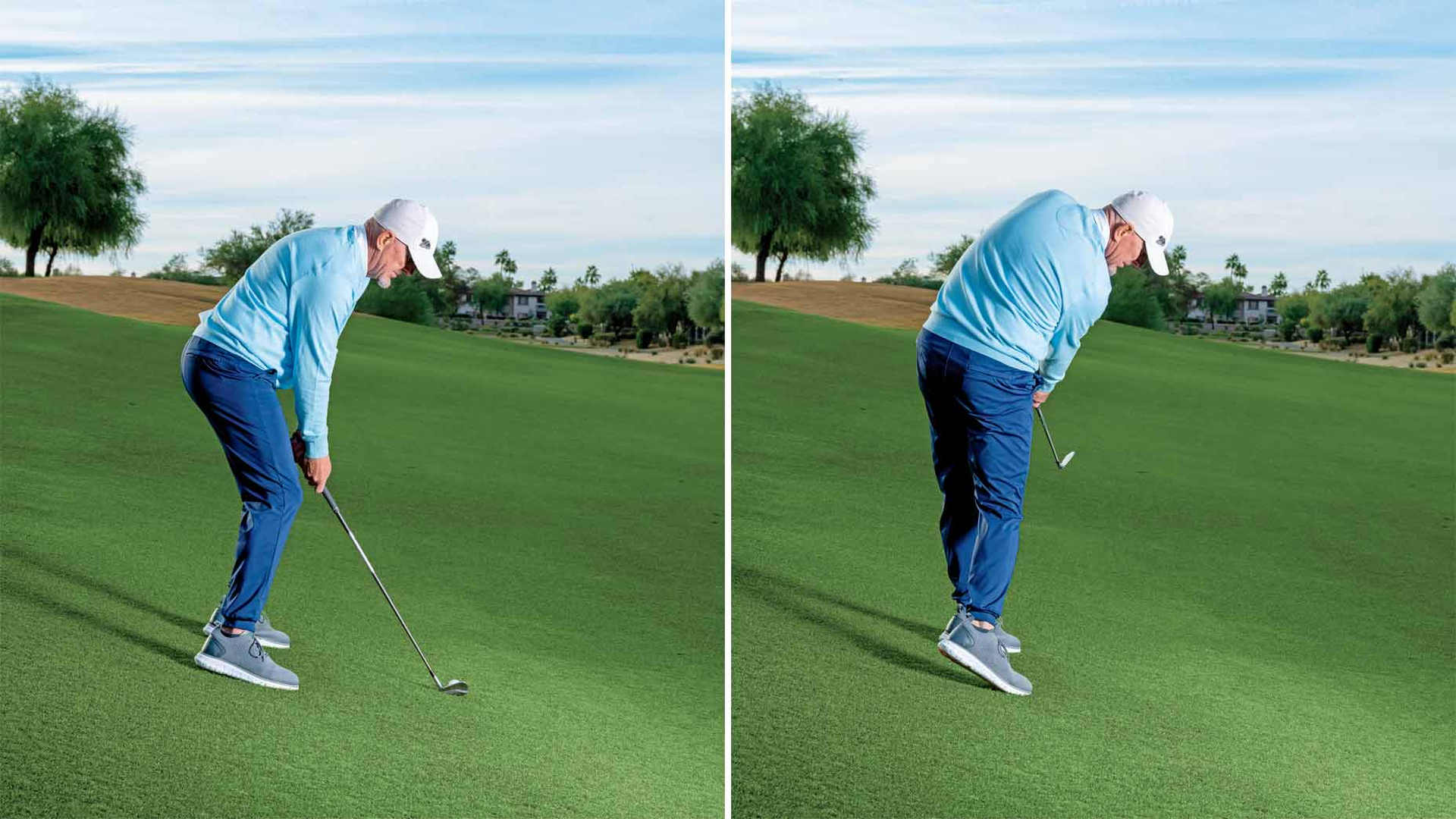
1. What is a sidehill lie?
A sidehill lie is a lie where the ground slopes across your target line rather than up or down it. Your feet and the ball end up at different heights, which changes your posture, the shape of your swing and the direction the ball curves. There are two types: the ball above your feet and the ball below your feet.
A useful way to predict the curve is to imagine rolling the ball along the ground from where it lies. In most cases, it will curve in the air in the same direction. The advice below assumes a right-handed golfer, so left-handers should reverse every left and right.
2. How to play a ball above your feet
2.1. Adjust your setup
When the ball sits above your feet, the ground is closer to your hands than usual. Grip down on the club by an inch or two so you do not catch the turf before the ball. Stand slightly taller, because you do not need to bend as far to reach it. Keep your weight centred or slightly towards your heels. If your weight drifts onto your toes, the slope can pull you forward during the swing and affect your balance.
2.2. Aim, club choice and swing
From this lie, your swing becomes flatter and the clubface tends to close through impact, so the ball usually curves left. Aim to the right of your target to allow for this. The steeper the slope and the more lofted the club, the more the ball will curve. A wedge therefore needs more allowance than a long iron.
Because you are holding the club shorter, take one extra club, for example a 6-iron instead of a 7-iron. Make a controlled three-quarter swing rather than a full one, as it is easier to stay balanced. Then let the ball curve as planned. Trying to hold the clubface open to stop the draw often produces a weak shot to the right.
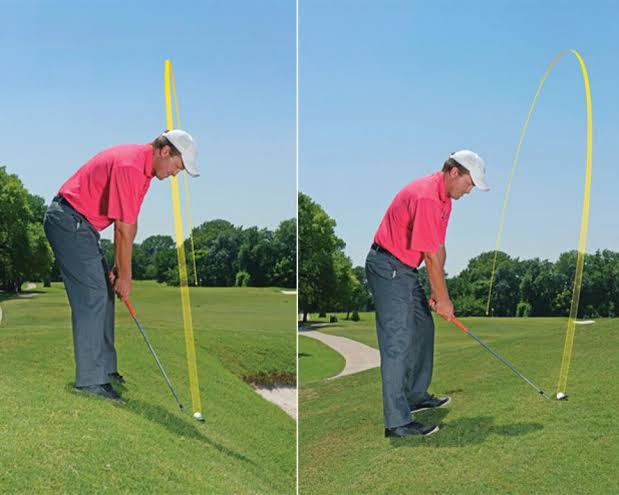
3. How to play a ball below your feet
Many golfers find this lie more difficult. The ball is further away from you, and the most common misses are thin shots and shots that drift right.
3.1. Adjust your setup
Hold the club close to the end of the grip so you can use its full length. Widen your stance and add more flex in your knees. The aim is to lower your whole body towards the ball, not to bend further from the waist. Bending over too much makes it easy to stand up during the swing and catch the ball thin. Put a little more weight towards the balls of your feet and keep your knee flex from address to the finish.
3.2. Aim, club choice and swing
With the ball below your feet, the ball tends to curve to the right, so aim left of your target. The more the ball sits below your feet, the further left you will need to aim. Since the fade costs some distance, taking one extra club is a sensible starting point.
Your swing will naturally be more upright, which helps you reach the ball. Keep it compact and stay down through impact, as losing your posture is the main cause of poor contact. Coaches differ on ball position for this shot. Some keep it in the middle of the stance, while others move it slightly forward. It is worth testing both in practice to see which gives you cleaner contact.
4. What the Rules of Golf say about sidehill lies
An awkward slope also raises a few rules questions. The points below are based on the current Rules of Golf published by the R&A and the USGA, and apply to a ball in the general area.
4.1. Your stance on a slope
Rule 8 is based on the principle of playing the course as you find it. A slope is part of the course, so there is no free relief simply because the ball sits above or below your feet. You may place your feet firmly when taking your stance, including a reasonable amount of digging in with your feet in sand or loose soil. However, Rule 8.1a does not allow you to build a stance, for example by:
- placing a towel, a stone or another object under your feet or knees
- digging in excessively to create a flat platform on the slope
- altering the surface of the ground where you will stand
The Rules make it clear that you are not entitled to a normal stance or swing. A breach of Rule 8.1a carries the general penalty, which is two strokes in stroke play or loss of the hole in match play.
4.2. When the ball moves on a slope
On a steep slope, the ball may roll before you make your stroke. If natural forces such as gravity or wind moved it, there is no penalty, and you play the ball from its new spot. If you caused it to move, for example by pressing the club down behind the ball, you get one penalty stroke under Rule 9.4 and must replace it. You are only penalised when it is known or virtually certain that you were the cause. Otherwise, the ball is treated as moved by natural forces.
If you need to replace the ball and it will not stay on the slope, Rule 14.2e tells you to try a second time. If it still rolls away, place it on the nearest spot where it will stay at rest, not nearer the hole.
4.3. When to declare the ball unplayable
If the slope is too steep for a sensible stroke, you can declare the ball unplayable under Rule 19 anywhere except in a penalty area. Each option costs one penalty stroke:
- stroke-and-distance relief: play again from where you made your previous stroke
- back-on-the-line relief: drop behind the ball’s spot, keeping that spot between the hole and where you drop
- lateral relief: drop within two club-lengths of the ball’s spot, not nearer the hole
The last two options require you to know where the original ball lies. Before you choose, think about where the dropped ball is likely to finish. A drop on the same slope may leave you with another poor lie, and taking relief again means another penalty stroke.
5. Common mistakes to avoid when playing a sidehill lie in golf
Most poor shots from sidehill lies come from a small number of habits:
- Using your normal setup and ignoring the slope
- Aiming straight at the flag without allowing for the curve
- Swinging too hard and losing balance
- Trying to correct the curve with your hands instead of aiming for it
- Going for a difficult shot when a simple shot back to the fairway is the better option
A practice swing on a nearby slope of similar steepness helps you feel where the club will meet the ground. Just make sure it does not flatten or damage the area where you will play your stroke, as that could also breach Rule 8.1a.
Getting comfortable with how to play a sidehill lie in golf comes down to reading the slope, adjusting your setup and aiming for the curve rather than fighting it. The rules side matters too, since a wrong call about your stance or a moving ball can cost you strokes. If you are unsure of a ruling on the course, ask Golficial and get a clear answer in seconds.
>>> Download the Golficial app: