Few things change a hole faster than watching your ball splash into a pond guarded by yellow stakes. Knowing the rules for a yellow penalty area in golf can save you strokes and arguments with playing partners. This guide from Golficial explains what it is, how to tell if your ball is in one, and which options you have under the current Rules of Golf.
1. What is a yellow penalty area in golf?
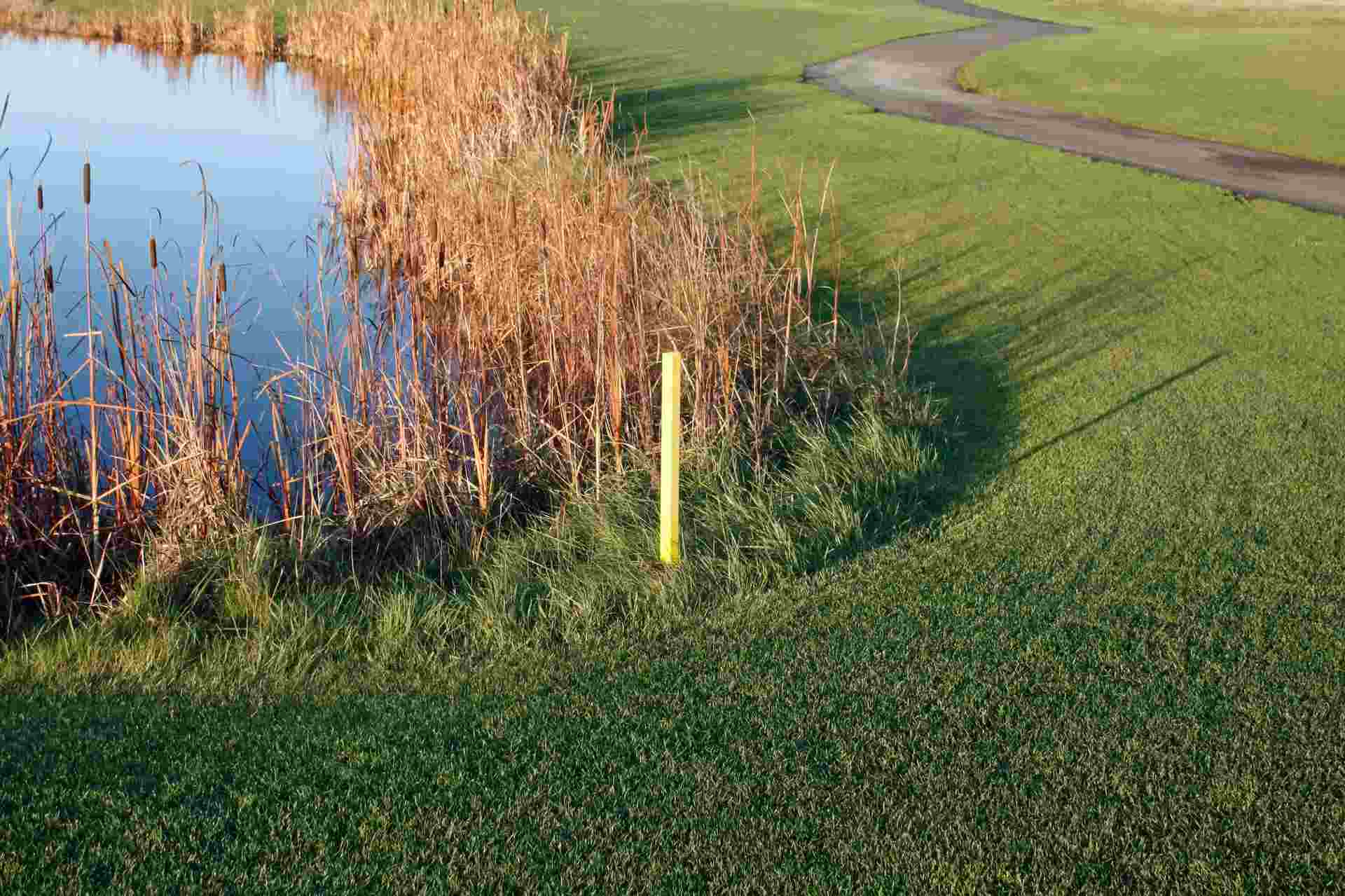
A yellow penalty area in golf is a section of the course marked by yellow stakes or yellow lines, where you can take relief for one penalty stroke if your ball comes to rest inside it. Most yellow penalty areas are ponds, streams, or ditches that cross the line of play, such as a creek in front of the green. However, the committee can also mark areas without water, like deserts or dense bushes.
Before 2019, the Rules of Golf called these areas water hazards. The 2019 rule changes replaced that term with penalty area and split it into two colours: yellow and red. Red penalty areas, which used to be called lateral water hazards, are usually found along the side of a hole and give you one extra relief option. If an area on the course is not marked at all, the rules treat it as red by default. The table below sums up the main differences.
| Feature | Yellow penalty area | Red penalty area |
|---|---|---|
| Marking | Yellow stakes or lines | Red stakes or lines |
| Name before 2019 | Water hazard | Lateral water hazard |
| Typical location | Across the line of play | Along the side of a hole |
| Play the ball as it lies (no penalty) | Yes | Yes |
| Stroke and distance (1 stroke) | Yes | Yes |
| Back-on-the-line relief (1 stroke) | Yes | Yes |
| Lateral relief within two club-lengths (1 stroke) | No | Yes |
| Default when unmarked | No | Yes |
2. How to tell if your ball is in a yellow penalty area
2.1. How the edge is marked
When a yellow penalty area has both stakes and painted lines, the line defines the edge and the stakes only show where the area is. The stakes and lines themselves are inside the penalty area, so a ball touching a yellow line is already in it. If only stakes are used, the edge is the line between the outside points of the stakes at ground level.
The edge also extends straight up and straight down. This means a ball resting on a branch hanging above the area, or sitting in a hole below the ground inside the edge, still counts as being in the penalty area. Knowing exactly where the edge is matters, because every relief option starts from the point where your ball last crossed it.
2.2. When your ball counts as being in the penalty area
Your ball is in a penalty area when any part of it touches the ground or anything else inside the edge, or lies above it. A ball sitting half on the grass outside and half on the yellow line counts as being inside. The same applies to a ball resting in the water, on a muddy bank or against a stake within the edge.
To take penalty area relief, you must know or be virtually certain that the ball is in the penalty area. Virtually certain is generally understood as at least 95% sure. If you didn’t see it go in and there’s a fair chance it’s lost in long grass nearby, you can’t assume it found the water. In that case, the ball is treated as lost, and you must take stroke and distance relief.
3. Your relief options in a yellow penalty area
Once your ball is in a yellow penalty area, Rule 17 gives you three choices. One is free, and two cost a single penalty stroke. The right option depends on where the ball lies, how confident you are in the shot, and how far back you’re willing to go.
3.1. Play the ball as it lies
You can play the ball from inside the penalty area without any penalty. This is often realistic when the ball is sitting on dry ground near the edge or in very shallow water. Since 2019, you’re allowed to ground your club, move loose impediments such as leaves and twigs, and touch the ground or water during practice swings.
You still can’t improve the conditions for your stroke, for example by breaking branches or pressing down the ground behind the ball. It’s also worth knowing what you lose here. You cannot take free relief from abnormal course conditions inside a penalty area, and the unplayable ball rule does not apply there. If the shot is too risky, one of the penalty options below is usually the safer choice.
3.2. Stroke and distance relief
For one penalty stroke, you can play a ball from where you hit your previous shot. If that shot came from the teeing area, you can tee the ball up again anywhere inside the teeing area. If it came from the fairway or rough, you drop a ball within one club-length of that spot, no nearer the hole.
This option is simple and always available, but it gives up distance. Golfers usually choose it when the back-on-the-line option would leave an awkward angle or a poor lie, or when the water sits right in front of the tee.
3.3. Back-on-the-line relief
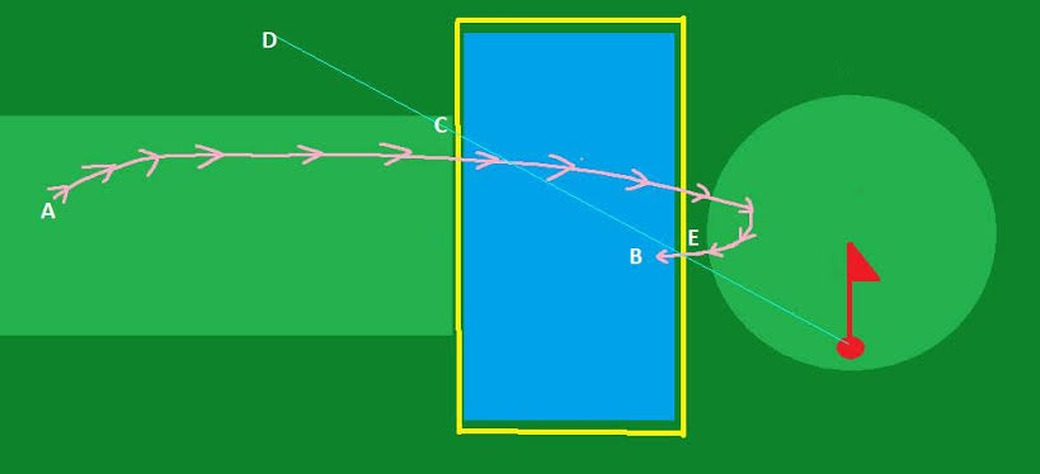
Also for one penalty stroke, you can drop a ball behind the penalty area on a straight line. First, find the point where your ball last crossed the edge of the penalty area. Then imagine a line from the hole through that point and continue it backwards, away from the hole. There’s no limit on how far back you can go.
Under the 2023 Rules, you drop the ball directly on that line. The ball must come to rest within one club-length of where it first hit the ground, and not nearer the hole. A club-length is measured with the longest club in your bag other than your putter. This option is useful when going back a little gives you a comfortable yardage for your next shot.
4. 5 Common mistakes golfers make with yellow penalty areas
Even experienced players get these situations wrong. Here are the errors seen most often:
- Using the spot where the ball came to rest. Relief is measured from where the ball last crossed the edge, not where it ended up in the water.
- Taking lateral relief from a yellow area. Dropping sideways is only allowed for red penalty areas.
- Assuming the ball is in the water. Without knowledge or virtual certainty, the ball must be treated as lost.
- Improving the lie when playing it as it lies. Grounding the club is allowed, but bending grass or breaking branches to help the stroke is not.
- Dropping in the wrong place. Playing from the wrong place usually carries the general penalty: two strokes in stroke play or loss of the hole in match play.
A yellow penalty area in golf gives you three options: play the ball as it lies, return to your previous spot, or drop back on a line from the hole. Remember that yellow never allows lateral relief, and always measure from where the ball last crossed the edge. If you’re unsure about a ruling on the course, ask Golficial for a quick answer or download the Golficial app (iOS / Android) to keep the rules in your pocket.